

Table of Contents
- Understanding the Meaning of Intestacy
- The Rules of Intestate Succession in Ontario
- Who is Appointed as the Estate Trustee?
- Comparing DIY vs. Professional Estate Administration
- The Risks of Managing an Intestate Estate Alone
- Frequently Asked Questions
- Conclusion: Taking the Next Steps
Summary Highlights
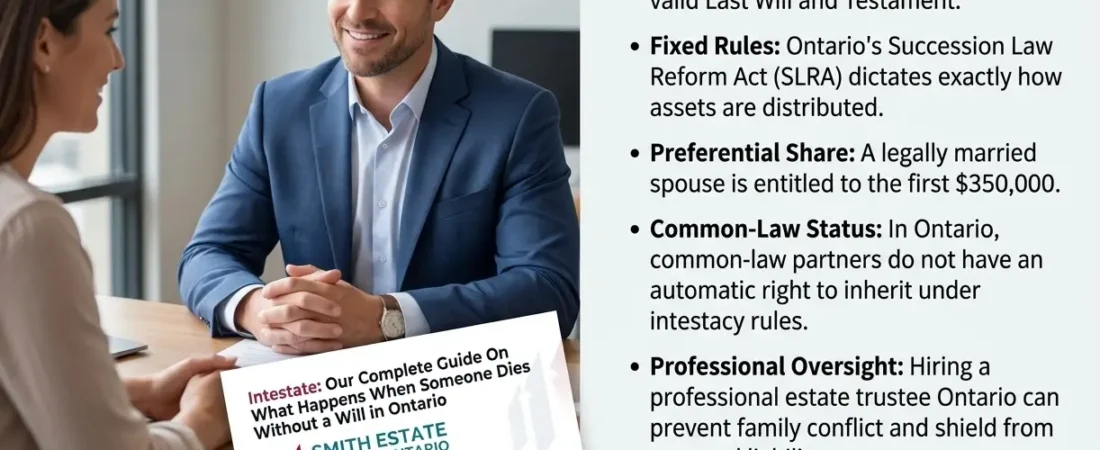
- Definition: Dying “intestate” means a person has passed away without a valid Last Will and Testament.
- Fixed Rules: Ontario’s Succession Law Reform Act (SLRA) dictates exactly how assets are distributed; family members cannot change these rules.
- Preferential Share: A legally married spouse is entitled to the first $350,000 (currently set at this amount) of the estate before other beneficiaries receive a share.
- Common-Law Status: In Ontario, common-law partners do not have an automatic right to inherit under intestacy rules.
- Professional Oversight: Hiring a professional estate trustee Ontario can prevent family conflict and shield individuals from personal liability.
When a loved one passes away without a will, it creates a complex legal situation known as being intestate Ontario. Navigating the lack of clear instructions requires a deep understanding of provincial laws to ensure assets are distributed correctly and debts are settled. Without a will, the government’s “default” plan takes over, which may not reflect the deceased’s actual wishes.
Intestate: Understanding the Meaning of Intestacy
When you begin researching this topic, the first thing you need to understand is the intestate meaning. Simply put, the definition of intestate is the condition of an estate where the deceased person did not leave a valid will. This could happen because they never wrote one, the will they wrote was improperly witnessed and declared invalid, or they revoked a previous will without creating a new one.
In these cases, there is no “Executor” because no one was named in a legal document to take charge. Instead, someone must apply to the court to become the estate trustee Ontario without a will. This role carries the same heavy responsibilities as an executor but involves more rigorous court oversight and specific legislative hurdles.
The Rules of Intestate Succession in Ontario
Ontario follows the Succession Law Reform Act (SLRA) to decide who gets what. If you are dealing with estate administration Ontario for someone who died without a will, the distribution follows a strict hierarchy.
The Married Spouse’s Priority
If the deceased was legally married (and not separated under specific legal conditions), the spouse is usually the first in line.
- The Preferential Share: The spouse receives a “preferential share” which is currently set at the first $350,000 of the net estate.
- Sole Inheritance: If the estate is worth less than $350,000, the spouse inherits everything, even if there are children.
- The Residue: If the estate is worth more than $350,000, the spouse gets the first $350k, and the remainder is split between the spouse and the children (or grandchildren).
What About Common-Law Partners?
It is a common misconception that common-law partners have the same rights as married spouses. In Ontario, a common-law partner has no automatic right to inherit assets under the SLRA if their partner dies intestate. They may have to file a “dependent’s support” claim or a constructive trust claim in court to receive anything, which is a costly and stressful legal battle.
The Order of Distribution (If No Spouse)
If there is no surviving married spouse, the estate is distributed in this order:
- Children: Divided equally among them.
- Parents: If no children, the estate goes to the parents.
- Siblings: If no parents, it is split among brothers and sisters.
- Next of Kin: If no immediate family, it goes to nieces, nephews, or more distant blood relatives.

Intestate: Who is Appointed as the Estate Trustee?
Since there is no will to name a person in charge, someone must step forward. In Ontario, the court must issue a Certificate of Appointment of Estate Trustee Without a Will.
Usually, the person with the highest “priority” applies. This is typically the surviving spouse, followed by the children. However, the court will only grant this certificate if the applicant is a resident of Ontario. Furthermore, if multiple people have equal priority (like three siblings), they must all agree on who will act, or apply jointly.
If your family is experiencing tension or if the estate is complex, this is where family disputes often begin. This is also where a professional estate trustee Ontario like Smith Estate Trustee Ontario becomes invaluable by acting as a neutral, expert third party.
Intestate: Comparing DIY vs. Professional Estate Administration
Managing an intestate estate is a full-time job with significant legal risks. Here is how a DIY approach compares to hiring a professional.
| Feature | Family Member (DIY) | Professional Estate Trustee (Smith Estate) |
|---|---|---|
| Legal Knowledge | Often limited; prone to procedural errors. | Deep expertise in SLRA and Ontario probate law. |
| Time Commitment | Significant (often 12–18 months of work). | Efficiently managed by dedicated specialists. |
| Personal Liability | High; personally liable for tax/debt errors. | Smith Estate Trustee assumes the liability and risk. |
| Conflict Resolution | Hard; often caught in family emotional crossfire. | Impartial third party; minimizes family friction. |
| Bonding Requirement | Usually must post a high-cost insurance bond. | Professional status can simplify bonding hurdles. |
| Accounting | Often informal and legally insufficient. | Transparent, CPA-led financial reporting. |
The Risks of Managing an Intestate Estate Alone
If you decide to handle estate administration Ontario yourself, you are stepping into a minefield of potential liabilities.
- The Administration Bond: When there is no will, the court almost always requires the applicant to post an “administration bond.” This is essentially an insurance policy for the value of the estate to protect beneficiaries. It can be very difficult for an individual to qualify for this bond without professional help.
- Personal Liability for Debts: As the trustee, you are responsible for paying all of the deceased’s debts and taxes before giving any money to beneficiaries. If you distribute money too early and a creditor (like the CRA) comes knocking, you may be personally responsible for paying that debt out of your own pocket.
- Complex Tax Filings: You must file a final “terminal” tax return for the deceased and potentially “estate” tax returns for the duration of the administration. Errors here can lead to heavy penalties.
- Family Conflict: Intestacy often brings out long-standing family grievances. If a sibling feels they are being treated unfairly or that you are taking too long, they can take legal action against you.
Using a professional estate trustee Ontario ensures that the process moves forward transparently and according to the letter of the law, protecting you from these risks.

Intestate: Frequently Asked Questions
1. Does the government take the money if there is no will?
This is a myth. The government only takes the money (a process called “escheatment”) if absolutely no blood relatives can be found, no matter how distant. In 99% of cases, the money goes to the family members identified in the Succession Law Reform Act.
2. How long does the intestate process take?
Without a will, the process usually takes longer than a standard probate application. You can expect a minimum of 12 to 18 months. The court application for the certificate itself can take several months, depending on the jurisdiction in Ontario.
3. Can I skip probate if there is no will?
Almost never. Financial institutions like banks and land registry offices will rarely release assets of an intestate person without a court-certified Certificate of Appointment of Estate Trustee Without a Will. You can read more about common estate mistakes here.
4. What if I find a will later?
If a will is discovered after a trustee has been appointed, the court must be notified immediately. The previous certificate may be revoked, and a new application will be required based on the terms of the newly found will.
Intestate Conclusion: Taking the Next Steps
Dying intestate Ontario adds a heavy layer of bureaucracy and stress to an already difficult time. While the law provides a roadmap for distribution, the actual work of estate administration Ontario is technical and fraught with risk.
If you have been left to manage an estate without a will, you do not have to do it alone. Whether you need a professional estate trustee Ontario to take over the entire process or just need guidance on the court application, Smith Estate Trustee Ontario is here to help. We provide the impartiality and financial expertise needed to close the estate correctly, quickly, and without further family conflict.
Contact Smith Estate Trustee Ontario today for a compassionate consultation on your estate administration needs.
Disclaimer: This analysis is for educational purposes only and is based on the cited sources and professional expertise as an Ontario Estate Trustee and a Licensed Insolvency Trustee. The information provided does not constitute legal or financial advice for your specific circumstances. Every situation is unique; the outcomes discussed may not apply to your particular case. Don’t hesitate to get in touch with Smith Estate Trustee Ontario to discuss your specific needs.
About the Author:
Brandon Smith is a Senior Vice-President at Ira Smith Trustee & Receiver Inc. and a Licensed Insolvency Trustee serving clients across Ontario. His experience includes acting as a court-appointed Estate Trustee in Ontario, giving him practical insight into navigating challenging situations to achieve optimal outcomes for all beneficiaries. Brandon stays current with landmark developments, ensuring his clients benefit from a cutting-edge understanding of their rights and options.

#intestateOntario #intestatemeaning #definitionofintestate #intestate #intestateontario #estateadministrationOntario #estatetrusteeOntario #probateOntario #successionlawreformact #smithestatetrusteeontario