Table of Contents
- Summary Highlights
- Introduction: Understanding the Ontario Probate Process
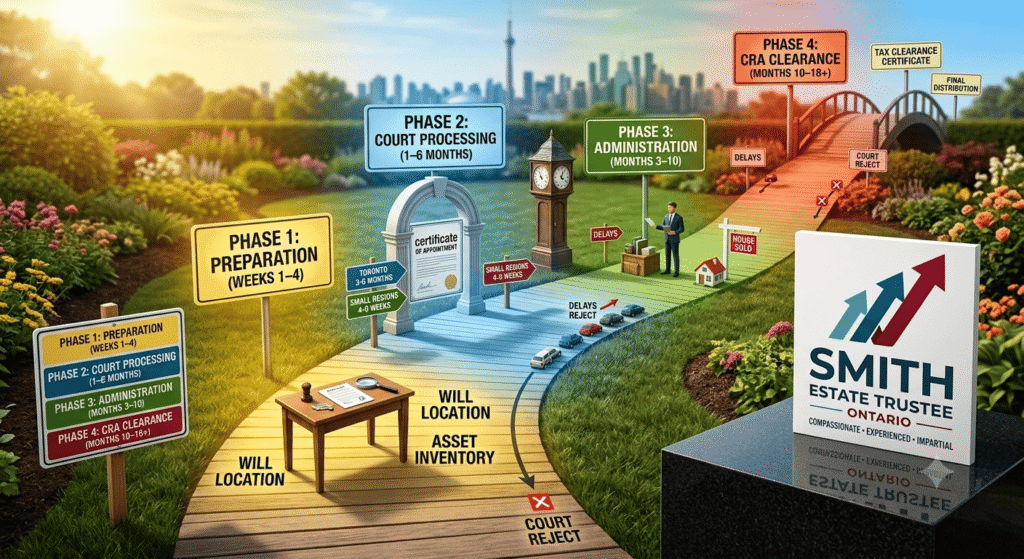
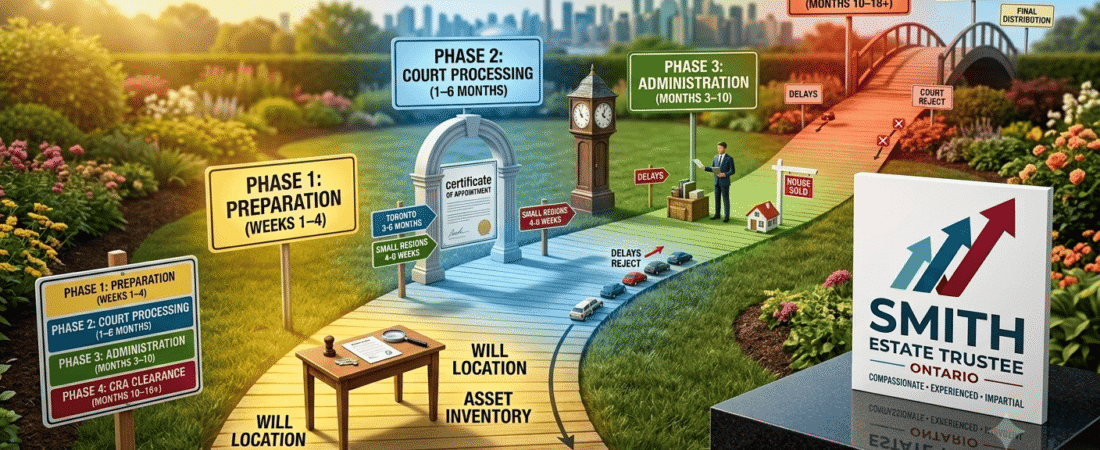
- Phase 1: Initial Preparation and Application (Weeks 1–4)
- Phase 2: Court Processing and Obtaining the Certificate (1–6 Months)
- Phase 3: Comprehensive Estate Administration (Months 3–10)
- Phase 4: CRA Clearance and Final Distribution (Months 10–18+)
- Comparison: DIY vs. Professional Estate Trustee Timelines
- Common Factors That Delay Probate in Ontario
- Frequently Asked Questions (FAQs)
- Conclusion: Streamlining Your Estate Administration
Probate Ontario Summary Highlights
- Probate Ontario Average Duration: A straightforward estate typically takes 8 to 12 months to fully settle, while complex cases can last 1.5 to 3 years.
- Court Processing: In 2026, court turnaround for a certificate of appointment of estate trustee Ontario ranges from 4–8 weeks in smaller regions to 3–6+ months in Toronto and the GTA.
- Initial Steps: Document gathering and asset valuation generally require 2 to 4 weeks before filing.
- Probate Fees: The probate fees Ontario (Estate Administration Tax) are $0 for the first $50,000 and 1.5% for every $1,000 above that threshold.
- CRA Wait Times: Obtaining a Tax Clearance Certificate from the CRA is the longest waiting period, often taking 4 to 6 months after the final tax return is assessed.
- Professional Advantage: Engaging professional estate trustee services can reduce delays by ensuring application accuracy and impartial communication among beneficiaries.
Probate Ontario Introduction: Understanding the Ontario Probate Process
Dealing with the death of a loved one is emotionally taxing, and the subsequent legal requirements for probate Ontario can often feel like an overwhelming burden. You may be wondering exactly how long you will be tied to administrative tasks or when beneficiaries can expect their inheritance. While the government strives for efficiency, the reality of estate administration Ontario involves multiple stages, from court filings to federal tax clearances. This guide provides a direct, matter-of-fact timeline to help you navigate the process with clarity and manage expectations for all involved parties.
Probate Ontario Phase 1: Initial Preparation and Application (Weeks 1–4)
Before you can file your probate application Ontario, you must complete significant groundwork. This phase is about accuracy; mistakes here will cause the court to reject your application months later.
- Locating the Will: Confirming you have the original, valid Last Will and Testament.
- Asset Inventory: Identifying and valuing all assets (bank accounts, real estate, investments) as of the date of death.
- Notice to Beneficiaries: Serving notice to all individuals named in the Will or those entitled to inherit under intestacy laws.
- Calculating EAT: Determining the probate fees Ontario due at the time of filing. Remember, you must pay the Estate Administration Tax upfront when submitting your application.
If you are acting as the estate trustee Ontario, this is the most labour-intensive period for documentation.

Probate Ontario Phase 2: Court Processing and Obtaining the Certificate (1–6 Months)
Once the probate application Ontario is submitted to the Ontario Superior Court of Justice, the timeline is largely out of your hands. The time it takes to issue your certificate of appointment of estate trustee Ontario depends heavily on the court’s location.
- Toronto and GTA: Due to high volumes, expect a wait of 3 to 6 months. Some Toronto applications have been known to stretch beyond 8 months if the court faces unexpected backlogs.
- Smaller Jurisdictions: Courts in regions like Ottawa, Kitchener, or smaller northern municipalities often process clean applications within 4 to 8 weeks.
During this period, the court verifies that the Will is valid and that you are the proper person to act. Until you receive the certificate, most financial institutions will not allow you to move or close the deceased’s accounts.
Probate Ontario Phase 3: Comprehensive Estate Administration (Months 3–10)
With the certificate in hand, you have the legal authority to manage the Ontario probate process actively. This phase involves “winding down” the deceased’s life.
- Securing Assets: Transferring bank balances into an estate account and preparing real estate for sale.
- Paying Debts: Identifying creditors and settling outstanding balances, including utilities, credit cards, and funeral expenses.
- Interim Distributions: If the estate is clearly solvent, you might make a partial distribution to beneficiaries, though we advise caution and retaining a significant holdback for taxes.
Probate Ontario Phase 4: CRA Clearance and Final Distribution (Months 10–18+)
The final hurdle in estate administration Ontario is the Canada Revenue Agency (CRA). You must file a terminal tax return for the deceased and often a T3 trust return for the estate.
The how to probate a will in Ontario guide isn’t complete without mentioning the Tax Clearance Certificate. This certificate confirms the deceased owes no further taxes. Without it, you, as the trustee, could be held personally liable for any unpaid taxes if you have already distributed the assets.
- CRA Assessment: 2–4 months after filing returns.
- Clearance Certificate Request: 4–6 months for the CRA to process.
- Final Distribution: Once the certificate arrives, the final accounting is presented to beneficiaries, and the remaining funds are distributed.

Probate Ontario Comparison: DIY vs. Professional Estate Trustee Timelines
Probate Ontario: Common Factors That Delay Probate in Ontario
If your estate is taking longer than the average, it is likely due to one of these common bottlenecks:
- Toronto Court Backlogs: As noted, the physical location of the filing is the single biggest factor in the initial wait.
- Incomplete Documentation: Missing affidavits or incorrectly valued assets lead to court “rejections,” forcing you to start the wait time over.
- Will Challenges: If a family member files a Notice of Objection, the probate Ontario process stops immediately until the litigation is resolved.
- Complex Assets: Business interests, foreign property, or niche investments require specialized valuations that extend the preparation phase.
- CRA Delays: Missing tax records from previous years can delay the final clearance by several months.

Probate Ontario Frequently Asked Questions (FAQs)
1. Can I sell the deceased’s house before probate is granted?
In most cases, you can list the property and even sign a secondary agreement of purchase and sale, but you cannot “close” the sale or transfer the title until the court issues the certificate of appointment of estate trustee Ontario.
2. How much does probate cost in Ontario in 2026?
The probate fees ontario are 1.5% of the estate’s value over $50,000. For an estate worth $1,000,000, the tax would be $14,250.
3. Do all estates need to go through probate?
Not necessarily. Small estates (under $50,000) have a simplified process. Assets with designated beneficiaries (like RRSPs or Life Insurance) or assets held in joint tenancy with right of survivorship often pass outside of probate.
4. What happens if there is no Will?
This is called “intestacy.” The process is similar, but you must apply for a Certificate of Appointment Without a Will, and Ontario’s Succession Law Reform Act dictates who inherits.
Probate Ontario Conclusion: Streamlining Your Estate Administration
The Ontario probate process is a marathon, not a sprint. While a typical timeline spans approximately one year, your primary goal should be accuracy and the mitigation of personal liability. Attempting to rush the process often leads to errors that cause even longer court delays or tax complications.
If you feel overwhelmed by the responsibilities of being an estate trustee Ontario, or if you want to ensure the process moves as quickly as the law allows, we can help. Smith Estate Trustee Ontario provides the professional oversight needed to navigate these timelines with compassion and technical precision.
If you are ready to begin the probate process or need professional guidance to handle a complex estate, contact us today for a consultation.
Disclaimer: This analysis is for educational purposes only and is based on the cited sources and professional expertise as an Ontario Estate Trustee and a Licensed Insolvency Trustee. The information provided does not constitute legal or financial advice for your specific circumstances. Every situation is unique; the outcomes discussed may not apply to your particular case. Please contact Smith Estate Trustee Ontario to discuss your specific needs.
About the Author:
Brandon Smith is a Senior Vice-President at Ira Smith Trustee & Receiver Inc. and a Licensed Insolvency Trustee serving clients across Ontario. His experience includes acting as a court-appointed Estate Trustee in Ontario, giving him practical insight into navigating challenging situations to achieve optimal outcomes for all beneficiaries. Brandon stays current with landmark developments, ensuring his clients benefit from a cutting-edge understanding of their rights and options.